Lower House
The Man Who LaughsThe Lower House is the chamber associated with the people in the book’s account of the English legislature. Its dealings with the House of Lords expose a political order in which the two Houses participate in legislation but do not meet as equals: procedure makes the Commons’ deference to the peers visible in dress, posture, and the handling of bills.
Identity and Institutional Setting
The Lower House appears as one chamber of a legislature whose counterpart, the House of Lords, is also described as a court of justice. The Commons are identified with the people, while the peers hold the superior ceremonial position. The contrast is not merely a difference in titles: it shapes how representatives approach the Lords and how the two bodies communicate.
The account provides no comparable description of the Lower House’s internal organization or membership. Its institutional character is conveyed instead through its relationship with the peers: it has bills to present and a role in negotiations, yet enters the Lords’ chamber in a posture of formal submission.
Ceremony and Unequal Standing
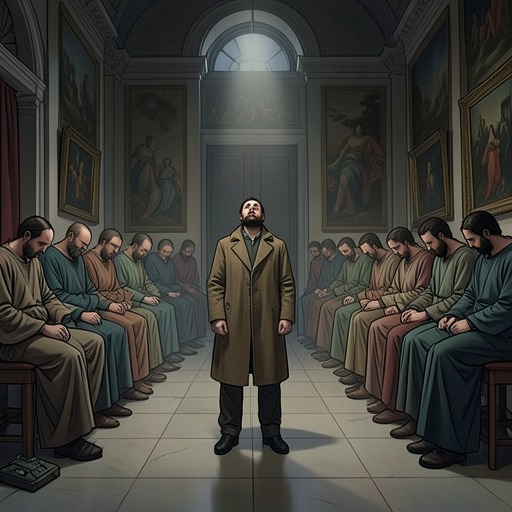
When ordered to the bar of the House of Lords, members of the Lower House present themselves bareheaded, while the peers remain covered. The difference in headwear turns hierarchy into a public ritual: the Commons’ bodily deference is required even as they appear before a chamber in which legislation is conducted.
The contrast continues in the prescribed forms of address and movement. Members of the Lower House approach the Lords as a body expected to show humility; peers retain the marks of rank associated with their standing. These rules frame institutional contact as an encounter between the people’s chamber and an hereditary elite, not as an exchange between equal parties.
Bills and Inter-House Procedure
The procedure for transmitting bills makes the asymmetry especially clear. The Lower House sends its bills through forty members, who present each bill with three low bows. The House of Lords, by contrast, sends its bills to the Lower House through a single clerk. Thus the same legislative exchange takes a ceremonious, collective form when it proceeds upward from the Commons, but a comparatively plain administrative form when it proceeds back.
When the Houses disagree, they confer in the Painted Chamber. Even there, their positions are distinguished by posture: the peers sit and remain covered, while the Commons stand bareheaded. Conference provides a means of addressing disagreement, but the staging preserves the hierarchy rather than suspending it.
Rank, Visibility, and Significance
The peers’ privilege also extends beyond the chamber into public display. They travel to Westminster in coaches arranged in file, and some go in open four-wheeled chariots. Coaches bearing coats of arms and coronets, along with the use of these chariots, are reserved to peers and count as part of their dignity. The account therefore places parliamentary distinction within a broader system in which status is made visible in both procedure and daily public appearance.
Taken together, these details define the Lower House less through its internal workings than through the limits and formalities placed on its dealings with the House of Lords. Its bills enter a shared legislative process, and disagreements can be discussed, but the prescribed bows, uncovered heads, standing posture, and unequal modes of transmission give that participation a distinctly subordinate form.